Silicone Mould Production
Fast, economical silicone tooling for low volume production and prototype validation.
Overview
At volumes where steel tooling cannot be justified, silicone moulding is the right answer on both time and cost. Tooling is ready within days and parts can be cast in properties close to the production material.
The process starts with a master model, produced by machining or additive manufacturing and finished carefully, since its surface quality transfers directly to the final part.
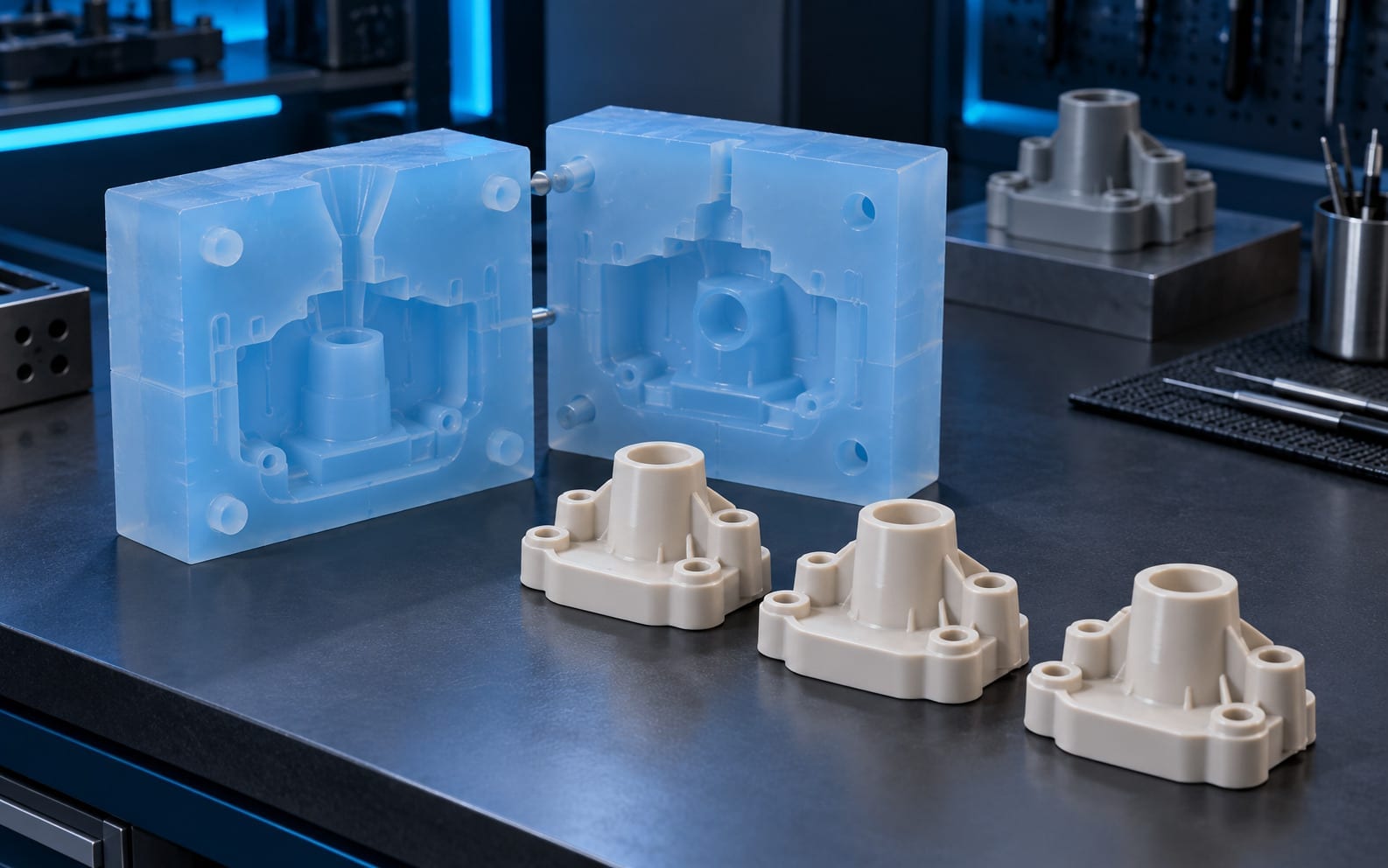
Silicone cast under vacuum reproduces the master with high fidelity. Once the mould is split, polyurethane resins are cast by vacuum casting, with colour, hardness and transparency chosen close to the end product.
Silicone tool life is limited and varies with the resin used. This method is not an alternative to series production but a fast bridge for pre-series, market testing and assembly validation.
How we proceed
- Step 01
Master model
The model is produced and finished to the required surface quality.
- Step 02
Parting plan
The split plane and casting direction are determined.
- Step 03
Silicone casting
Silicone is cast under vacuum and left to cure.
- Step 04
Mould opening
The mould is split, the master removed and gates opened.
- Step 05
Part casting
Polyurethane resin is cast under vacuum; parts are finished and delivered.