Transformer Winding Mould Production
Dimensionally stable moulds and fixtures for dry type and cast resin transformer windings.
Overview
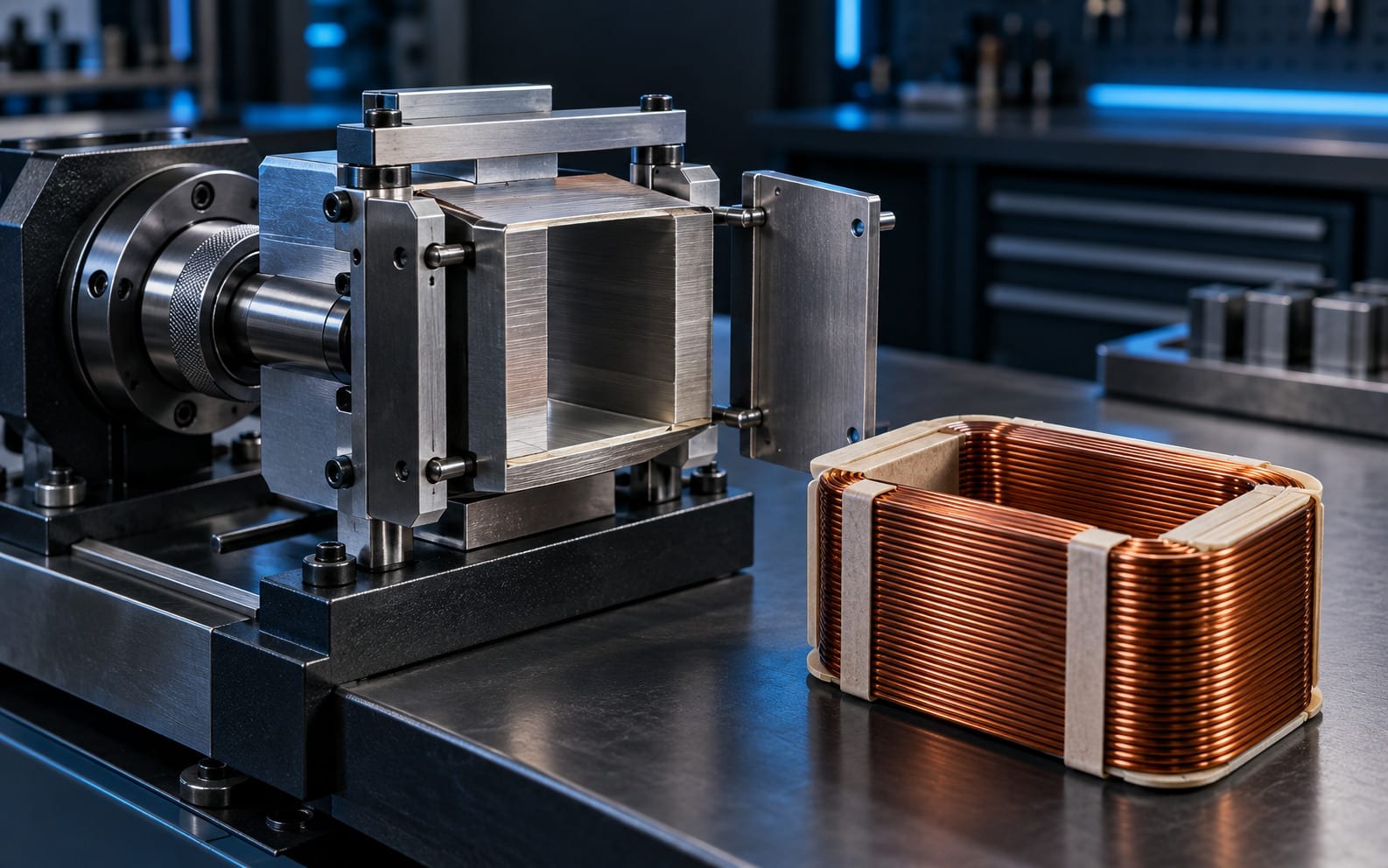
In transformer winding tooling, tolerance translates directly into electrical performance. Because deviations in winding geometry affect insulation distances and heat distribution, dimensional stability matters more here than in most applications.
Mould design follows the requirements of the winding method and the insulation material. In cast resin applications, the behaviour of the mould under vacuum and temperature is the governing design constraint.
Draft angles and separable mould elements are planned so the winding can be released without force; forced removal damages both the winding and the tool.
For repeat production across power classes we work with a mould family approach, designing interchangeable inserts on a common frame to reduce investment cost.
How we proceed
- Step 01
Specification
Power class, winding geometry and insulation requirements are defined.
- Step 02
Mould concept
Tool type and split arrangement are set according to the winding method.
- Step 03
Detail design
Draft angles, thermal behaviour and removable elements are designed.
- Step 04
Manufacturing
Mould elements are machined and surface finished.
- Step 05
Trial winding
A sample winding is produced and the tool delivered after dimensional checks.